
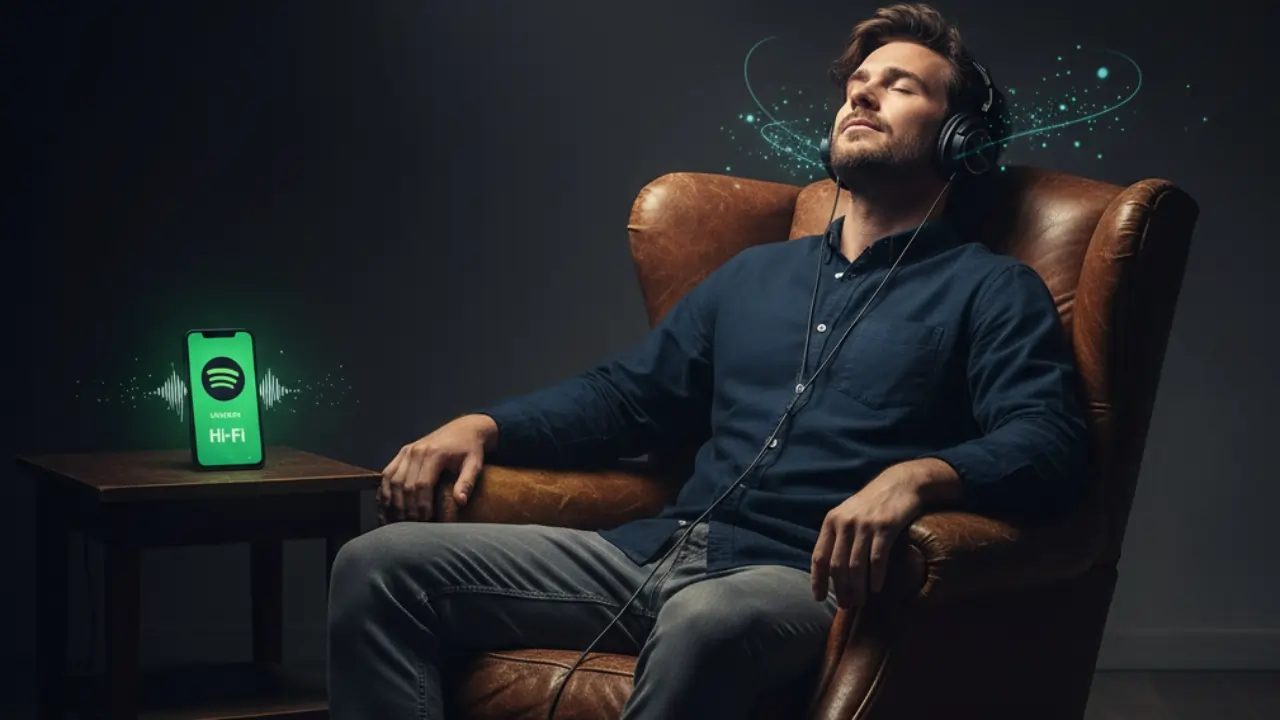
It finally happened. I honestly thought I might be writing about the flying car first, but here we are. After years of promises, delays, and deafening silence, Spotify has officially started rolling out lossless audio. And the best part? It’s free for all Premium subscribers. But hold the applause. My reaction isn’t excitement. It’s frustration.
Spotify’s Lossless Audio: The Celebration That Feels Years Too Late
Let’s be clear: this is good news. For years, we audiophiles and music nerds have been begging Spotify, the undisputed king of music streaming, to give us a higher-quality audio option. We watched as Apple Music, Amazon Music, and Tidal all launched their high-fidelity tiers, leaving Spotify in the dust. Today, Spotify finally caught up to the starting line of a race that began years ago.
The company has started flipping the switch, giving Premium subscribers access to lossless audio at no extra cost. The rollout has begun in several countries and is expected to hit over 50 markets by the end of October. This is a huge win for sound quality. So why does it feel so anticlimactic? Why does it feel like Spotify just did the bare minimum, years after it stopped being impressive?
A Quick Refresher: What is “Lossless” and Can You Even Hear It?
Before we get too deep, let’s quickly break this down. The music you usually stream on Spotify is “lossy.” To save data, the file is compressed, and tiny bits of audio information that your ear supposedly can’t hear are thrown away. Lossless audio, on the other hand, is a perfect, bit-for-bit copy of the master recording from the studio. It’s CD-quality or better.
Now for the million-rupee question: can you actually hear the difference? My honest answer: it depends.
If you’re listening on cheap Bluetooth headphones while riding the metro, probably not. The background noise and the limitations of your gear will mask any subtle improvements. But if you have a decent pair of wired headphones (like the Audio-Technica M50x), a good DAC (Digital-to-Analog Converter), and you’re listening in a quiet room, you absolutely can. The music feels like it has more space, more “air.” Cymbals sound crisper, basslines feel tighter, and you can pick out individual instruments more clearly. It’s not a night-and-day difference for everyone, but for those who care, it matters.
The Elephant in the Room: Apple and Amazon Did This Ages Ago… For Free
Here’s my biggest issue with this whole announcement. Spotify isn’t being generous here; they’re playing catch-up. Apple Music made its entire 100-million-song library available in lossless audio way back in 2021. For free. Amazon Music HD did the same.
For years, rumors suggested Spotify was planning to launch a more expensive “HiFi” or “Supremium” tier. They were going to ask us to pay more for a feature their biggest competitor was giving away as a standard. I can only assume they finally looked at the market and realized how ridiculous that would look. Making it free for Premium users wasn’t a choice; it was the only move they had left to stay relevant in the quality debate.
The Data Demon: A Warning for Indian Mobile Users
Okay, let’s get practical, especially for us here in India. Lossless audio files are massive. A standard three-minute song on Spotify might be around 5MB. A lossless version of that same song can be anywhere from 30MB to 50MB. That’s a huge jump.
If you’re sitting at home on a fast Wi-Fi connection, go nuts. Download your favorite albums and enjoy the quality. But if you plan on streaming lossless audio on your mobile data plan while commuting, you need to be very, very careful. A single hour of lossless streaming could chew through more than a gigabyte of data. For most of us on standard prepaid plans, that’s a significant chunk of our daily limit gone in the time it takes to get from Churchgate to Borivali. My advice is to use this feature to download songs on Wi-Fi, not to stream on the go.
So, is This a Reason to Switch Back to Spotify?
For the past couple of years, I’ve had to maintain two subscriptions: Spotify for its amazing recommendation algorithm and playlisting, and Apple Music for when I wanted to do some serious, high-quality listening. This new update finally solves that problem.
If you left Spotify for another service purely for sound quality, this might be the moment you’ve been waiting for to come back. You can finally have the best of both worlds: Spotify’s brilliant user experience and high-fidelity audio. But if you’re already happy with Apple Music’s interface and library, there’s nothing here that’s a compelling reason to switch. Spotify hasn’t leapfrogged the competition; they’ve just achieved parity.
Your Lossless Audio Checklist
- You Need a Premium Subscription: This feature is not available for users on the free, ad-supported tier. You must be a paying Spotify Premium subscriber.
- You Need Good Gear to Appreciate It: To hear the real benefit of lossless, you’ll need a good pair of wired headphones or high-quality speakers. Most standard Bluetooth earbuds can’t transmit the full range of lossless audio.
- Watch Your Mobile Data Usage: Streaming lossless audio on the go will consume a massive amount of data, so it’s best to download tracks over Wi-Fi for offline listening.
- It’s a Phased Rollout: The feature is being rolled out gradually. If you don’t see the new quality option in your settings yet, just be patient, as it should appear in the coming weeks.
The Streaming Wars: Quality Showdown
| Feature | Spotify | Apple Music | Amazon Music |
| Lossless Audio | Yes (Rolling out now) | Yes | Yes |
| Hi-Res Audio | Not yet confirmed | Yes (up to 24-bit/192 kHz) | Yes (up to 24-bit/192 kHz) |
| Spatial Audio | Not yet confirmed | Yes (Dolby Atmos) | Yes (Dolby Atmos & 360 Reality Audio) |
| Extra Cost | No | No | No |
Frequently Asked Questions
How do I turn on lossless audio in Spotify?
Once the update rolls out to your device, you should be able to go into the app’s settings, find the “Audio Quality” section, and you will see a new option for “Lossless” or “HiFi” for both Wi-Fi and Cellular streaming, as well as for downloads.
Do my existing downloaded songs automatically become lossless?
No. To get the benefit of the higher quality, you will need to delete your existing downloads and re-download them with the new “Lossless” quality setting selected. This will take up significantly more space on your device.
Will this work with my Bluetooth headphones like AirPods or Sony XM5s?
This is a tricky one. Bluetooth technology itself involves a layer of compression. So, while the source file is lossless, the transmission to your headphones is not. You will likely get a higher-quality stream than before, but it won’t be true, bit-perfect lossless audio. For that, you need a wired connection.
I’ve turned it on, and I honestly can’t hear a difference. Am I doing something wrong?
You’re not doing anything wrong, and you’re not alone! The difference can be very subtle and depends heavily on the specific song, your hearing, and your audio equipment. Don’t feel bad if it doesn’t sound like a night-and-day change. Just enjoy the music, knowing you’re hearing it at its best possible quality.
